Welcome to Minnesota!
We’ve already had an 80 degree day and what is in the forecast for the next two days?? Snow! For the past 2 nights it has been getting very close to 38/39 degrees Fahrenheit. I have 1 hanging flower pot and one standing that I have been bringing inside overnight just in case.
I also have onions, radishes, peas and carrots in the garden that I will need to protect the next two nights. I plan on using bed sheets and mini shepherd’s hooks to secure a little shelter for the garden plants. I will also use pillow cases for my rose bushes.
If by chance my greenhouse plastic comes I might try to construct my roll-back greenhouse and use that instead! 🙂
Thanks for stopping by!
~Sara
Hi everyone!
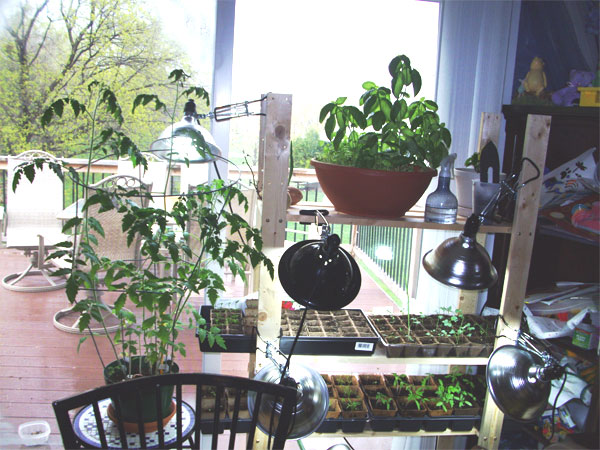
I have an updated picture of the indoor garden for you! It is growing like mad, and it’s so neat to have a bit of summer right in my dining room.
The giant monster tomato plants (started Feb 1st) that are actually pretty normal size are on the far left. On the very top of the shelf is the potter that has the cilantro and basil (started Feb 1st) which are still going strong and I have had several small harvests out of!
The next shelf down from L-R are seedlings (started March 27th) of jalapenos, alyssum, petunias (regular ones that are still hard to germinate and extremely small and slow growing so far), bell peppers, broccoli, and large yellow onions.
Next shelf down are seedlings of alyssum, carrots, and 3 different varieties of tomato plants.
(The alyssum was started some time at the end of March.)
Everything that you see besides the large tomato plants and the cilantro and basil at the top will be transplanted some time around May 20, which is our frost-safe date according to the farmer’s almanac!
In a few weeks I will do another short video before I do the transplant so you can see how big they get before I transplant them.
Thanks for stopping by!
~Sara
I planted my onions, radishes and peas today!
A ton of large yellow onions, snow peas and dwarf peas, and cherry globe radishes! I planted a ton of radishes because once they are done I will clean out that part of the garden to plant other things in, so I use more than I normally would.
Here is a nice little guide for when to plant stuff:
Very early spring (as soon as the ground can be worked)
* Onions
* peas (Martha Stewart plants hers every year on St. Patrick’s Day – she lives in New England!)
* spinach
Early spring
* lettuce
* beets
* carrots
* radishes
* dill
* cilantro
* cabbage
* broccoli
* celery
* kale
* potatoes
After last frost date
* beans
* corn
* melons
* cucumbers
* squash
* tomatoes
* peppers
* pumpkins
* eggplant
* basil
Happy Planting!
I was just reading my Farmer’s Almanac for this year and found out the meaning behind the term “Victory Garden.”
In 1588 Queen Elizabeth sent riders out into the country side to tell the folks out there to prepare for war. One of the main things that was told to everyone through out the land was to plant extra food in their home gardens because without it they would be going hungry. This is was part of the reason the English were victorious over the Spanish invasion!
Likewise during WW2 the department of agriculture told people to start home gardens (which at that time were few and far between here in the U.S.) to relieve the demand for food in the grocery stores. Many families took this advice and ate better (and a lot healthier) for it!
So, the Victory Garden is just that – a sustainable way for families to maintain themselves during times of war. Thinking about all of the ways this effects the whole country is amazing to me. A war can be won due to sustainable living, in particular – gardening for our selves and not relying on the grocery stores to be there for us.
This is just as true now as it was back then. Gardening this way can conserve energy and also keep us healthier!
Here is a short tour of my current indoor garden setup.
[flashvideo file=”https://sarasgardenmarket.com/videos/indoorg_tour_large.flv” /]
In my search for the eternal summer I have started an indoor garden here in Minnesota! The purpose; to be able to garden from seed to table year-round.
I have started some seeds indoors before with mixed results. Most of the seedlings got too tall and toppled over and died. Some of them were too wet all the time and their roots rotted. When it finally came time to transplant these babies to the outdoor garden the majority of them died because they were not hardened properly. There are a lot of gardeners out there, particularly in the Northern United States that just go buy their plants at the garden stores at the start of the season claiming that starting seeds just doesn’t work.
Patti inspired me to try again with the seed starting and also to try a full out indoor garden! She has so many videos and so much awesome information on how to do it all how could I go wrong?
So, apparently the first time I tried to start seeds I did not have an adequate source of light. That’s why the plants got too tall – they said “I need light!!!!!!!!!!!!” Also, when you garden indoors you need more movement in the air so the top soil dries out in between waterings to prevent root rot. This air circulation also helps in the hardening process before you transplant! All of this makes a lot of sense, so I am going at it again!
Thanks for coming along for the ride!
Greenly, Sara M.